I DON’T DRAW…I PAINT WITH FABRIC AND THREAD (Part 1)

‘I can’t draw.’
It’s probably one of the most common things I hear from people who admire textile art but don’t believe they could ever create it themselves. They see a realistic bird, a flower, a landscape or a beautiful portrait made from fabric and thread and immediately think, ‘There’s no way I could do that. I can’t even draw a straight line!’
Here’s the secret: You don’t need to be able to draw to create beautiful textile art. You need to learn how to look.
SEEING INSTEAD OF DRAWING
When I create a piece of textile art from a photograph, I’m not trying to copy every little detail. I look at the photograph differently and I ask myself questions such as: Where are the darkest areas? Where does the light fall? Which colours are really there, even though my eyes might initially see them as simply ‘brown’, ‘green’ or ‘blue’? Where are the shadows? Which direction is the fur, feather, grass or water moving? I’m looking for shapes, colour, texture, light and movement.
Once you start seeing those things, a complicated image becomes much less intimidating.
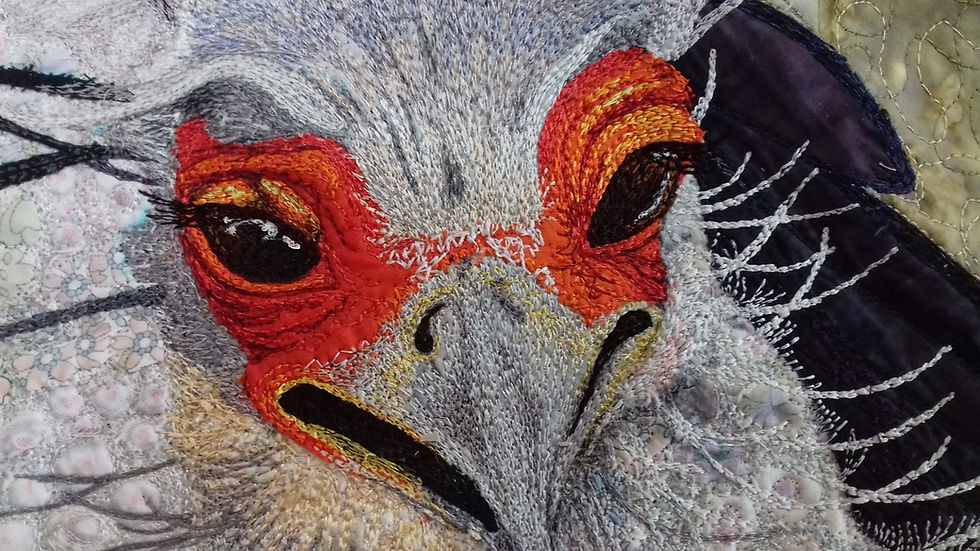
A bird, for example, isn’t simply a bird. It can be broken down into a collection of shapes and colour areas. The body might be one shape, the wing another and the shadows and highlights create the illusion of form. Suddenly, you don't have to ‘draw a bird’ anymore! You simply have to work out how to build those shapes with fabric and thread.
FABRIC BECOMES MY PAINT
Instead of reaching for a pencil or paintbrush, I reach for my box of fabric scraps. A tiny piece of fabric can become a shadow. Another can suggest a highlight. A frayed edge might be exactly what I need to create the softness of a feather or the texture of grass. Sometimes I’ll audition dozens of fabrics before finding the one that feels right and that is part of the fun! I’m not necessarily looking for a fabric that looks exactly like the photograph, I’m looking for one that will suggest what I am trying to create. This is where fabric collage becomes so exciting. You can layer, overlap, cut, fray and rearrange pieces until the image begins to emerge.

THEN COMES THE THREAD
Once the fabric is in place, the thread takes over. This is where my sewing machine becomes my drawing tool as well as my paintbrush! Using free-motion stitching, I can create lines that follow the direction of feathers, grass, leaves, waves or hair. I can add shadows, highlights and movement and I can use different colours and weights of thread to create depth and texture. Just as a painter doesn't necessarily paint every blade of grass, I don't need to stitch every feather. This is definitely an area where even I, need to slow down on the amount of stitching that I do. I tend to over stitch a project instead of allowing the fabric to show off.

Sometimes less is more. A few carefully placed lines can tell your eye that something is soft, fluffy, shiny, rough or moving. The magic happens when your eye fills in the details that aren't actually there.

DON’T BE AFRAID OF COLOUR
Another thing that can stop people is colour. We often think we need the ‘correct’ colour but nature rarely works that way. Look closely at a photograph of a bird and you may find purples, blues, greens, oranges and greys hiding in what initially looks like a single brown feather.

The same is true of landscapes. A tree isn't simply green, water isn't simply blue and sand isn't simply beige! Once you start looking closely, you discover an extraordinary world of colour.

That is when textile art becomes much more interesting!
Stay tuned for next month’s blog where I will tell you more about how your photograph is your teacher! Yes, believe it, it is a thing!


I was watching a movie about an artist and a comment from his mentor struct me and has stayed with me, "See the color in the clouds." It has made an impression on me and I consider it every time I look at my quilts for ques for adding a spark of color that makes them glow.